Let’s Read Swim for fund-raising

GSA Hon Sec, Jo Hallett, writes:

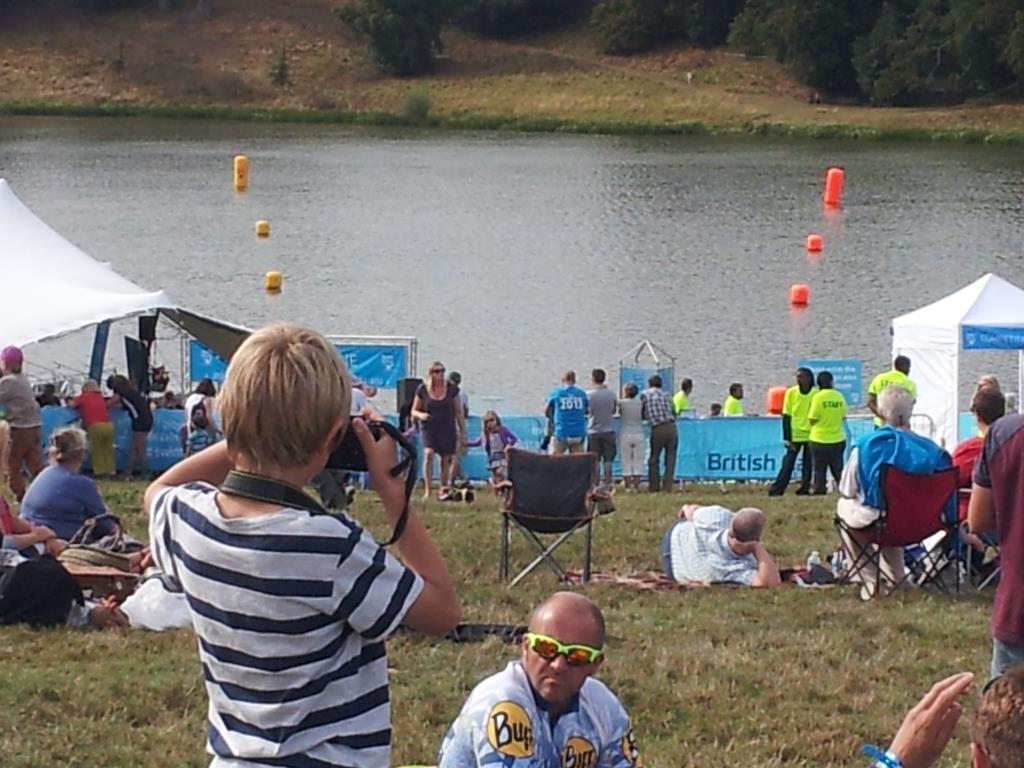
“This sounds exciting,” said Rob, my sporty son-in-law, “it’s a 4 km open water relay in the Blenheim Palace Lake – you up for it, Grandma Jo?”  “Why not?” I replied, without really thinking. // A few months later, I found myself squeezing into a cut-down beach wetsuit in a marquee near the lake which looked brown and cold, despite the sunshine – it turned out to be both! // We had 2 teams:  the Earlsdon Eels and the Hearsall Haddocks, with four people in each.  The route ran out from the edge of the lake and back, around a series of buoys.  That was 250 metres, so we swam round 4 times in turn, a total of 1 km each.

Walking down the ramp into the dark, chilly water, timing chip safely secured round the ankle, was just the first challenge!  Once in the lake, it’s “every man for himself”, no allowances for grandmas like me.  It’s a competitive race, with elbows flying, legs kicking, bodies whizzing past, even over the top!  You have to keep your nerve.  Rob had indeed warned me that such events are “a bit physical”!  //  Because we went in and out of the water 4 times, it was pretty cold, but drinks, snacks and space blankets were provided.  It was all very exhilerating and jolly, and the sun shone!  Finishing, I felt a great sense of achievement:  I had made it!  But what’s more, I was swimming for GSA and Let’s Read.  Sponsorship money from my generous friends and family came to over £500!  In the end, our teams did OK,  We were not the first, but we weren’t the last either.  The fastest of us swam 1 km in 20 minutes and I took 32 minutes.  But I did find out later that I was the oldest competitor in the Open Water event.  Not bad for 69!!”

20130901_154232

Fund-raising by Colin MacBean

Colin is wonderfully active in raising funds for Ghana School Aid.  He has a page on JustGiving, on which he writes:”A couple of years ago I ran my first 10k to raise money for Ghana School Aid in memory of my Dad who was a district education officer in Ghana in the 1950s.  People were incredibly generous and I raised over £900. // At New Year this year a friend challenged me to race him in the Edinburgh Half Marathon this year.  As I’d had a few drinks this seemed like a great idea, although I am older, slower and less fit than I was when I did the 10k.. // When I sobered up I t hought I should make the best of this and try to make the training worth while by raising some money for GSA.  They are a small charity so your donations can make a real difference.  Over the next 5 months I’ll be posting updates and photos of how I am getting on JustGiving and on Facebook. // Donating through JustGiving is simple, fast and totally secure. […] Gift Aid is reclaimed on every eligible donation by a UK taxpayer, so it’s the most efficient way to donate […]”.

We at GSA wish Colin all the very best with his training and his run.  We are seriously short of funds at the moment, so please, everyone, do your very best to help us by supporting Colin’s wonderful efforts!  Thanks so much.

Abonse Basic School

GSA has given grants to both Abonse Basic School and to Aseseeso Junior High School, two neighbouring schools in the Eastern Region, each of which has a partner in the UK.  The progress of both links is monitored by GSA trustee and committee member Letitia Boateng.  Letitia is also a member of the Abonse-Aseseeso Citizens’ Association, a diaspora group which gives active and valuable support to schools partnered with their communities of origin.

During a visit to the UK in the summer of 2013, Letitia was a guest of John O’Gaunt Community Technology College, Hungerford, Aseseeso Junior High’s partner, as well as Figheldean Primary School near Salisbury, partnered with Abonse Schools.  John O’Gaunt was celebrating its 50th anniversay, and part ofthe school’s history exhibition was a display of their link with Aseseeso.  Around the school, signs of the link’s influence could be seen from wall art and drums to recipes and a celebratory quilt made in the Textiles Department.    Such shared proof of the mutual benefits of linking gives pride and confidence to students and staff in both countries.

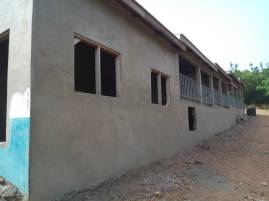
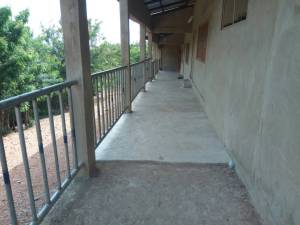
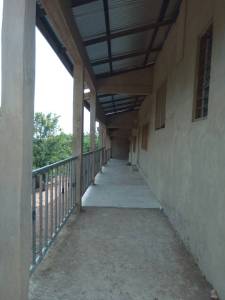
UPDATE       Letitia reports good progress made with the plastering.  The outstanding work is the need to rebuild the verandah at the back of the classroom block, which can house offices beneath it.  A grant of £500 was agreed in principle for this, but an estimate is needed before it can be released.  Patrick, the Abonse Head-teacher, came to the UK in October 2013 to visit the link school, Figheldean School.  He observed lessons and took teaching resources back to Abonse.  The challenge is to keep the link going now that British Council funding for it has ceased.

UPDATE        We received the estimates for completing the building of a veranda with storage area beneath it, and voted £1000 to this project.

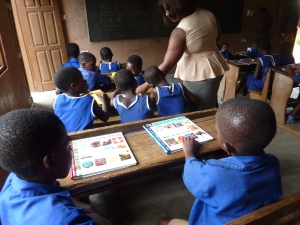
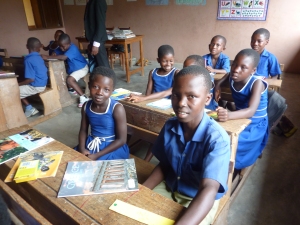
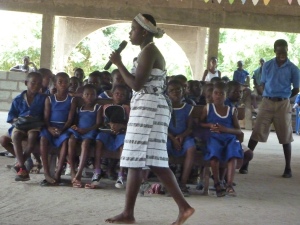
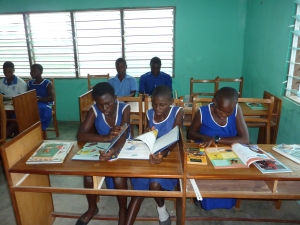
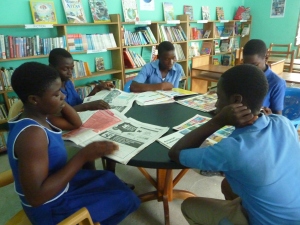
UPDATE MARCH 2016   Abonse is in the hills of the Eastern region near Akropong, and as a rural village, has a basic school on two sites that consists of a Kindergarten, a Primary and a Junior High School. The photos are of students in the JHS library, developed with voluntary help over the past five years, and of a primary class exploring books in their classroom.  The third picture is of a drama presentation.

Ghana 2015 075

Ghana 2015 076

Ghana 2015 058

Ghana 2015 197

Ghana 2015 204

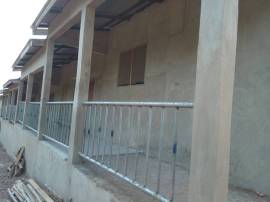
UPDATE February 2017  The big Abonse school project is near completion.  There is still some plastering, painting and the installation of protective railings to do.  GSA has awarded the school a grant of £1500 to complete this work.  We wish them well.

UPDATE  May 2017  Here are some recent pictures of the work.  We can see what a huge difference that veranda will make to ease of circulation in the school.

GEOFF PITCHFORD

Ghana School Aid is very sad to announce the death, on 25th May 2013, of Geoff Pitchford.  Geoff was a former Education Officer in Ghana, and a founder member of Ghana School Aid.  He joined the Education Department in the Gold Coast in 1949.  He had a variety of postings in Ghana, including one as Acting  Assistant Director of Education (Western Region), based at Cape Coast, and it was there that he met Myrtle who was working as a Domestic Science Organiser.  They were married in Cape Coast in 1958.  For the final two years of his time in Ghana, Geoff was Principal of Peki Training College in the Volta Region.  On his return to the UK he served in University College, Bangor and then in the University of Hull.  Geoff and Myrtle attended the first Ghana School Aid Weekend Reunion in 1986 and remained staunch supporters of GSA.  We extend our sincere condolences to Myrtle at this difficult time.

There will be a memorial service for Geoff on Saturday 28th September 2013 at 11am in Christ Church Cheltenham, Malvern Road, Cheltenham, GL50 2JH.  If you would like to attend, the contirubution of an anecdote or memory to this service would be welcome.  Please contact Karen Jones at [email protected]

KEYNOTE SPEECH AT 2013 AGM

We invited our long-standing supporter, Professor Lalage Bown to give the keynote speech after lunch.  Lalage was an Extra-Mural Tutor (attached to the University College in Ghana)  with responsibilty for Trans-Volta Togoland, from 1949 to 1955. She gave her speech with great gusto, complete with handout and some good jokes, to the delight and fascination of the diners.  Here is a summary of what she said.

Introduction               The reasons for telling this story were (a) that it was almost unknown, (b) it was in itself a good story, and (c) it contained messages for the present.  A striking characteristic of most of the University College staff was how young they were (I was 22 when I went off into Trans-Volta Togoland);  perhaps this was just as well for extra-mural tutors, since the work entailed rough living, very long car journeys, often camping overnight and make-shift housing.  A second important point was the early involvement of Gold Coasters as part-time tutors and senior department members.

The Point of Extra-Mural Studies                  When so few people had the chance of entering the College and when there were many able people in the country, the work was a  a fair use of some higher education resources.  Secondly, attendance at classes had a positive effect on people in outlying areas, since it gave them “ideas and encouragement”.  And thirdly, it met social needs by preparing people for social, political and economic change.  Though some Government officers understood and welcomed this, there were suspicions and I was, on one occasion, pursued by Special Branch.  On the other hand, when the UN Togo Mission came to report on British Trusteeship, the Government was pleased to show off the classes as preparing for independence!  (It was, however, a bit worrying that the Mexican member asked if I was “for rent”!)

How it Worked               A broad programme of weekly classes, weekend courses and public lectures and residential courses attracted all kinds of people with some formal education, among them, inevitably, many teachers.  Numbers grew rapidly, so that by 1955 there were more than 3500 class participants.

Outcomes                  Extra-Mural classes generated a wide spread of social projects, partly through links with the Community Development Department and partly through the extra-mural students’ own organisation, the People’s Educational Association, or PEA.  This democratic approach helped in bringing conflicting groups together, while leadership at all levels was fostered, since many educated chiefs participated, many trade union officials and elected representatives, e.g. almost all the Trans-Volta Togo regional council and 80 out of the 104 Legislative Assembly members.

Projects                        Major projects emerged and great efforts were made to involve more women;  one who had been sent to jail for demonstrating, placed such value on her class that she sent her warder to attend in her place!

Conclusion                    This was only a small part of a much longer story, since the University of Ghana still has a flourishing Institute of Adult Education.  I have many happy memories of those early days, not only of the rewarding nature of the work itself, but also of the extraordinary welcome and kindnesses I received from Ghanaians – such as the village woman who gave me the sole coin she had, a 3d piece, to buy eggs for my lunch.

AGM & REUNION LUNCH 13.6.13

Our AGM and Reunion lunch was attended by some 36 supporters, and 6 others had paid but were unable to attend.  Many others sent in generous donations for which GSA is extremely grateful.  We enjoyed the event very much and heard some encouraging reports of work being done in our name in Ghana.  Here is the text of the Chairman, Edward Mayne’s Report.

AKWABA

Where has the past year gone?  The AGM of 2012, held here at the John Adams Hall, brought together a group of supporters from different backgrounds who have a passion towards giving the children of Ghana opportunities of enjoying a good education.  On that occasion we were fortunate enough to have Lord Paul Boateng, who gave his time to address our meeting.  Like all of us, Paul shares our enthusiasm for the work we are doing, especially in the Northern and Upper Regions.  He is trying to identify a school in the Tamale district which would benefit from our support.  Also present was my former colleague Nick Elam who is well-known to our members in that he chaired the Caine Prize for African Literature which in the past has been awarded to Ghanaian writers.  Both Paul and Nick emphasised how well-educated a minority of Ghanaians have become and they are enthusiastic over the way we are creating openings for a few more.

As a committee we have been very active with our projects and the one which has recently got off the ground is at the Cambridge-Bethel school in Bethel-Awudome in the Volta Region, and founded by Patience Agbeti.  The school is close to the Joe Bedu Primary school at Daffor-Awudome which is supported by Penny Sewell in memory of her late husband.  Penny visits Daffor every two years and it was on one of her recent visits that she identified this struggling school.  We have had lovely letters from Patience and the development of the project is being closely monitored by Penny.  It was last year that we mourned the passing of one of our founder members, Pam Lewis, and following her death, her family set up a memorial fund with the request that it goes towards one of our projects.  The committee earmarked the Cambridge-Bethel school and, with the approval of Pam’s family, the funds raised in her memory will be allocated to this school.  We are advised that the fund now stands at over £4000.00, which will be used to build an extra classroom.

As a charity, we have always put much emphasis on linking schools in Ghana with those in the U.K.  We have continued with our stupport for the link between the Whitstone School at Shepton Mallett and the Otuapemman school at Akropong in the Volta Region.  Hopefully the coordinator, Miranda Liardet, is here today to update us on the work being done both in the Volta Region and Somerset.  What has been so encouraging in this case has been the mutual benefit of this project with everyone becoming more aware of each other’s needs.

It was around 7 years ago that I took over from Eric Earle as chairman.  At the time, GSA was on a firm foundation and was run with great enthusiasmj.  Since then we have seen our efforts take root and bear fruits in the Upper Regions.  Patrick Heinecke and the Sandema Project is just one example and, more recently, we have supportd Jo Hallett with her Let’s Read Project.  The way we work in conjunction with the Wuluga Projects shows that two charities can get together to work for the good of a large community, developing their skills in the Upper Regions.  These are areas crying out for help, yet sadly neglected by the authorities.  The British Airways School, now expanding even more, has been kept going due to our assistance, and the David Bradshaw memorial block is where 60 pupils are getting a good schooling.  Exciting days lie ahead.

I could go on for a long time reporting on our activities over the year, but will refrain from doing so because everything is recorded on our website and this afternoon you can be updated on our current projects.  In addition, our next newsletter should be be available in the autumn.

At last year’s AGM our long-serving treasurer and founder member Stanley Anthony announced that he would like to relinquish his duties before long.  He added that he is not planning to give up immediately, but we feel now is the time to recruit a willing volunteer.  I am advised that the work is not too onerous, especially as modern technology has taken over most of the book-keeping work.  So I am appealing to you to think about this duty and please let Stanley or me know if you feel able to assist.

The GSA committee has supported me very well since we last met and I would like to express my appreciation to all of them for all they have done over the year.  We hold our meetings every 3 months and there are rarely any apologies for absence, such is the enthusiasm for our work.  My reports in recent years have ended with quotes by Clement Atlee, Nelson Mandela and – more recently – Martin Luther King, and they were all related to the importance of education in the lives of the world’s citizens.  This time I want to quote from an address given by Sir Stafford Cripps.  While addressing pupils at Moncton Combe School in 1948, Sir Stafford said, “A gread deal of confusion in our minds comes from our lack of knowledge.  We cannot judge what is right unless we know what the consequences of our actions are likely to be on others.  That knowledge we can only gain by education and experience.  Education is, or ought to be, designed to make us intelligent and understanding citizens of our country and the world, able to judge what is right or wrong.  This can only be achieved through sensible schooling.”

Thank you all for your support for GSA.

Wesley Girls’ High School Headmistress

Ghana School Aid wishes to add its tribute to a remarkable lady who passed away on 30 January 2013, aged 86.  Clarice Garnett (latterly Clarice Howarth) was born in Rathmell, Yorkshire in 1927.  After completing a science degree at Oxford, she left for Ghana in 1950, aged just 23.  She joined Wesley Girls’ High School, Cape Coast as a biology teacher and Methodist missionary, and took over the headship in 1960, retaining it until her retirement in 1981 after more than 30 years at the school.  She was awarded Ghana’s highest accolade, the Grand Order of the Volta, and in the UK, the MBE for services to education.  Many former students occupy key positions in Ghanaian society, all are vocal about the debt they owe to their wonderful head teacher.  Many services are being held to honour Clarice, they are a testament to a life wholly productive in every way which has helped shape the Ghana we know today. Ayikoo!

Sabre Trust

The Sabre Trust is working in rural areas of Ghana to improve education.  This part of their project inolves an intensive one-year teacher training programme for Kindergarten teachers.  GSA has given the Trust a grant to provide KG resource boxes.  The following is quoted from the Trust’s very informative website, http://www.sabretrust.org:  “Sabre has developed a design for a resource box made from locally sourced and recycled materials that can complement teaching and small group activities. … The boxes contain building blocks, connecting toys, play mats and musical instruments, and the teachers will be supported to supplement them with resources that they can make themselves from recycled and reclaimed materials.”

UPDATE  JAN 2014  Here are some extracts from the Teacher Training Programme Year 1 Report.  “The key goal of this programme is to benefit young school children in Ghana by producing competent and compassionate kindergarten teachers familiar with the very specific learning needs of pre-primary pupils, skilled in an activity-based teaching and learning methodology which recognises the value of learning through play. […] The aim is to significantly enhance the quality of practical placements for trainee KG teachers enrolled on the diploma course.  Through this intervention, the student teachers receive strong practical training and classroom experience of child-centred and activity-based learning, giving them the confidence to implement this approach when posted as newly qualified teachers.    […]

Conclusion:  The overwhelmingly positive final reflections of the programme’s impact by teachers, mentees and head teachers at the final cluster meetings are testament to the hard work that has been put in by all involved.  All groups spoke of the improved changes in pupil behaviour, confidence and attendance at school.  Credit was also given to the programme for enhancing the teachers’ own understanding of what kindergarten teaching should be and how teachers can implement strategies to achieve these goals.  It is expected that the coming year will build on the foundations laid during this pilot year and use the lessons learnt to further develop the programme to be even more collaborative, consistent and effective.”

UPDATE 2015:  Supporting Africa by Rural Endeavour!  This charity focuses on Kindergarten education in the Cape Coast area.  We voted £1000 to enable the charity to complete the training of 3 KG teachers.

Tuskegee International School

This is a school located in Balansa-Oyarifa, a few miles west of Accra, founded by an inspirational leader called Charles Yarfoh, originally from the Upper Western Region.  Charles was not able to attend school himself for many years, because he was expected to look after the cattle.  When he did get to school he made great progress, trained as an engineer and worked in the civil service.  He wanted to give the same opportunity as he had had himself to children in a rural area, so he founded the Tuskegee School.  He is being supported by Bev Greenberg, known as “Greenie”, from the US, and features in the website http://www.caringkidconnections.com.

Arigu Village School

The project involved a young woman called Jessica Brown who had been a volunteer living in Arigu village for several months.  When she returned to the UK she ran the Brighton Half Marathon to raise funds for the school, which is much in need of support.  GSA was able to add to the sum that Jessica had raised and £1000 was sent to help the village school, via German company who have taken the village as “their” charity.